Washing and Laundry Blog
Biological versus Non-Biological Detergent : What Is the Difference?

How do Enzymes Work In Washing Powder
If you’ve ever stood in the supermarket looking at rows of washing powders and wondered “What’s the difference between biological and non-biological detergent?”, you’re not alone.
The answer is actually quite simple.
Biological washing powder contains enzymes. Non-biological washing powder doesn’t.
But what exactly do those enzymes do, and does using a biological detergent really make a difference to how clean your clothes are?
Let’s take a closer look. This blog was originally published in 2013 and fully updated in August 2026 to take account of enzyme improvements to 20 degree wash performance.
Biological Detergent
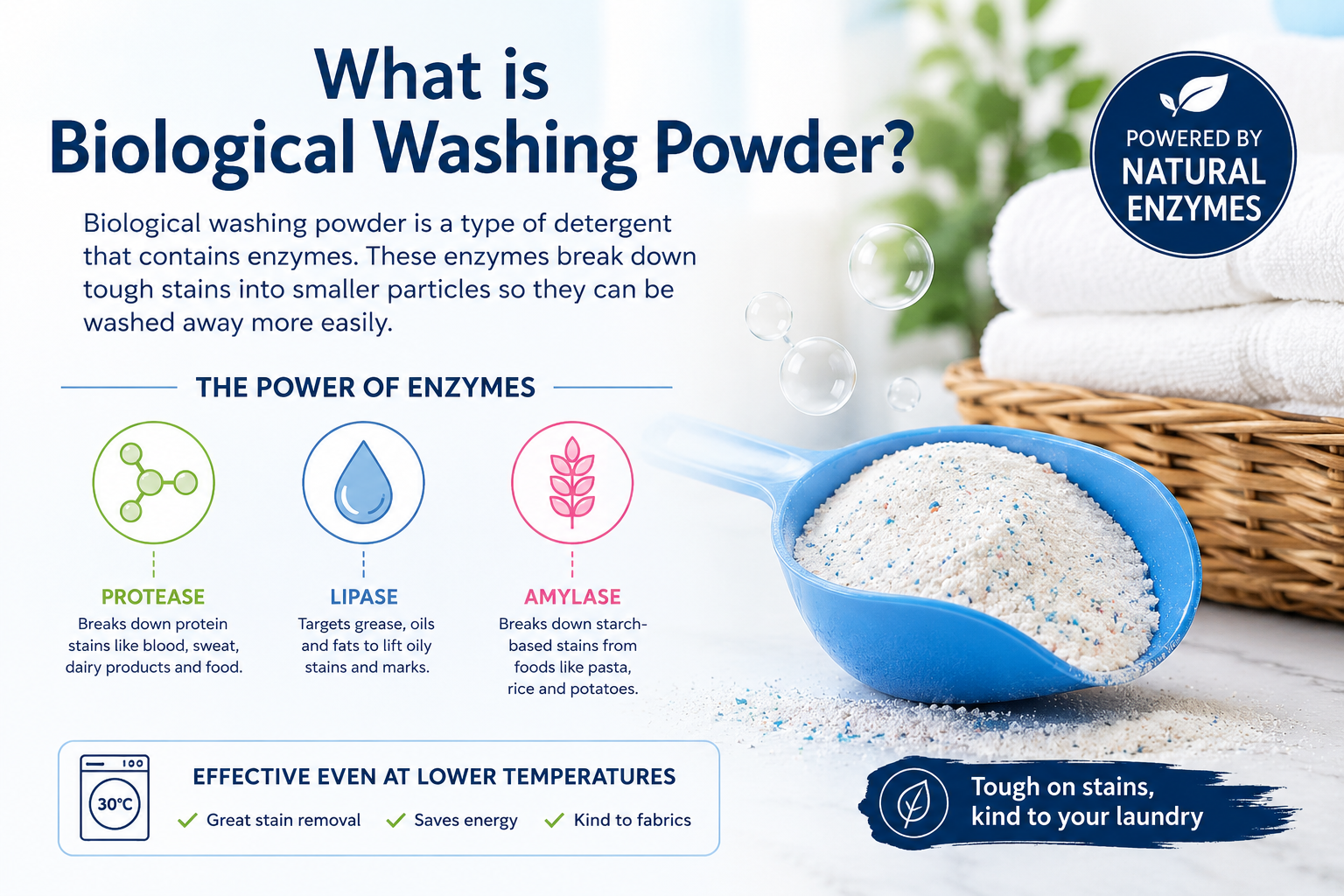
A biological detergent, often called a bio detergent, contains enzymes that help break down the types of stains and soils commonly found on clothing.
These enzymes work alongside the other cleaning ingredients in the detergent to break down dirt and stains, allowing them to be lifted away from the fabric during the wash.
One of the advantages of enzymes is that they can work effectively at lower washing temperatures, which is particularly useful when you’re trying to reduce energy consumption without compromising on cleaning performance.
At Distinctive, our biological washing powder is formulated to work effectively from 20°C, with 30°C being an ideal everyday washing temperature.
That’s quite different from relying on very hot water to do much of the cleaning.
You may remember enzymes from school biology lessons and the famous “lock and key” analogy.
Each enzyme takes a particular catalyst to start the reaction off. In our bodies digestion enzymes for example are controlled by temperature and ph levels caused by other factors like stomach acids. This is the same for Distinctive washing powder. We rely on heat reaching the 30 degree point and the effect of the other ingredients in the powder as they dissolve, which creates a certain alkalinity level in the wash.
An enzyme is designed to work on particular types of molecules. In laundry, different enzymes are used because different stains have different chemical compositions.
Think of it as having a small team of specialists rather than expecting one ingredient to tackle everything.

Protease – protein stains
Protease enzymes break down proteins.
Protein-based stains are particularly common in everyday laundry and can include food, sweat and other bodily soils.
Once the protein structure has been broken down, the other ingredients in the detergent can help lift the loosened material away from the fibres and keep it suspended in the wash water rather than allowing it to settle back onto your clothes.
Lipase – grease and fats
Lipase enzymes are particularly useful for breaking down fats and oily soils.
This makes them valuable for dealing with some of the greasy marks that ordinary washing can struggle with.
Amylase – starch based stains
Amylase enzymes target starches.
Foods such as pasta, rice, potatoes and sauces can leave starch-based residues behind, so amylase has an important role to play in a well-designed biological laundry detergent.
Why biological detergents work at lower temperatures?
This is one of the biggest advantages of a biological detergent.
Enzymes are highly effective catalysts. They help chemical reactions happen more efficiently, and are active usually at luke warm temperatures.
The exact performance depends on the formulation, the type of stain, the amount of detergent used, the length of the wash and the washing temperature.
That’s why simply turning the washing machine temperature up isn’t the answer for a deep clean – simply selecting a longer wash programme is likely to be the better option. .
A well-formulated biological detergent is designed to give a powerful clean using very little water and low temperatures.
At Distinctive, our powder is formulated around a combination of enzymes, surfactants, builders and other cleaning ingredients that work together during the wash.
PS.. (Builders are necessary compounds that make the water more alkaline or soften the clothes) So many people that don’t understand laundry chemistry think a builder is an unnecessary chemical )

What does alkalinity have to do with washing clothes?
Laundry detergent isn’t simply a collection of ingredients thrown together.
The different components have specific jobs.
The alkaline conditions created when the detergent dissolves help the cleaning process and can also assist with water softening.
This is important because minerals in hard water can interfere with cleaning.
By helping manage the water hardness, the detergent can work more efficiently and you may need less detergent to achieve a good wash.
This is one reason we recommend following the dosage instructions rather than automatically adding more powder because you have a particularly dirty load.
More detergent doesn’t necessarily mean cleaner clothes.
Biological vs non-biological detergent: what’s the difference?
The simplest way to remember it is:
| Biological detergent | Non-biological detergent |
|---|---|
| Contains enzymes | Does not contain enzymes |
| Uses enzymes to help break down specific stains | Relies on other cleaning ingredients |
| Can be highly effective at lower temperatures | Can also clean effectively, particularly at higher temperatures |
| Particularly useful for protein, fat and starch-based stains | Often preferred by people who choose to avoid enzymes |
| Available with or without optical brighteners | Available with or without optical brighteners |
It’s important to understand that non-biological doesn’t mean “bad” and biological doesn’t automatically mean “better” for every person or every wash.
Both types of detergent can clean clothes effectively.
The important difference is the cleaning technology used.
Does biological washing powder clean better?
For many everyday stains, biological detergents have a significant advantage because enzymes are specifically designed to break down certain types of organic soil.
However, washing performance depends on much more than whether a detergent is labelled “bio”.
The formulation, enzyme combination, surfactants, builders, water hardness, temperature, wash time and dosage all matter.
A poorly formulated biological detergent isn’t necessarily going to outperform a well-formulated non-bio detergent.
That’s why we believe the whole formulation matters.
At Distinctive, we’ve combined enzymes with other carefully selected cleaning ingredients to create a powder designed to deliver a deep clean while working at lower temperatures.
What about sensitive skin and biological washing powder?
There’s a common belief that biological detergents are automatically unsuitable for people with sensitive skin.
It’s not quite that simple.
An individual’s skin can react to a number of different substances, and everyone is different. The presence or absence of enzymes isn’t the only consideration when choosing a laundry detergent.
If you have particularly sensitive skin or a known allergy, it’s sensible to check the ingredients and follow advice from your healthcare professional.
It’s also worth remembering that fabric conditioner is a separate product from your detergent.
Fabric conditioners are designed to remain on the fabric to provide softness and fragrance. If you are trying to identify what is causing irritation, looking at the complete laundry routine rather than simply choosing “bio” or “non-bio” can be worthwhile.
What are optical brighteners?
Another common source of confusion is optical brighteners.
Optical brighteners are fluorescent compounds that absorb ultraviolet light and emit blue light, making fabrics appear brighter and whiter.
Importantly, biological does not mean that a detergent must contain optical brighteners.
A biological detergent can be formulated without them.
Distinctive washing powder contains no optical brighteners, which is an important part of our formulation philosophy.
We wanted a powder capable of cleaning everyday laundry without relying on optical brighteners to create the appearance of whiteness.
This is particularly relevant if you regularly wash coloured clothing, where maintaining the appearance of your clothes is just as important as getting them clean.

Laundry Myths
Sensitive skins really are not more likely to react to a bio!
Enyzmes provide a superior rinsing action to the last stage of the wash, meaning that there are less chemicals left on the surface of the fibres once the last rinse is completed. Whereas when you use a fabric softener at the last stage of the wash it never has the opportunity to be rinsed away so all the chemicals left sitting on fabrics cause problems with allergies.
A bio can contain optical brighteners (UV dyes that reflect light and make a product appear whiter than it is) or it can be without. There is no fixed rule for a detergent, so if you are avoiding them for delicate skin reasons, please look on the packaging. Anything that makes whites whiter generally has optical brightener content.
Optical brighteners are great for whites as you can imagine, but they leave a permanent change as a build up on a coloured or delicate item that makes coloured clothing look a little faded and patchy. You’ll see the UV speckles on other peoples clothing, (like dandruff) if you are under strobe lights in a nightclub.
Some washing formulas will also contain harsh bleaching agents – again, ours doesn’t for a reason, we want to look after mixed and expensive designer fibers in one easy washing load.
New Laundry powders in Europe have to be compliant with being fully biodegradable and phosphate free ( Laundry regulations). With Distinctive Washing powder all of our surfactants, (washing chemicals) are 100% environmental. It is something we are super proud of!

Do you need stain remover with biological washing powder?
This is another area where a good biological detergent can make life easier.
Because enzymes are specifically designed to target different types of organic stains, a biological detergent can deal with many everyday marks as part of the normal washing process.
That doesn’t mean every stain will disappear in one wash. Old, dried-in or particularly stubborn stains can still need additional treatment.
For a deep-set stain, one of the simplest things you can try is a pre-soak.
For example, you can dissolve a small amount of Distinctive washing powder in cool water and allow the garment to soak before washing it normally.
Sometimes giving the detergent more time to work is more useful than simply turning the washing machine temperature up.
Do biological detergents contain bleach?
Again, there is no rule saying that a biological detergent has to contain bleach.
Different laundry detergents use different combinations of ingredients.
Distinctive washing powder does not contain chlorine bleach or optical brighteners.
For everyday mixed laundry, we prefer a formulation that cleans effectively without trying to make every wash behave like a dedicated whitening treatment.
If you have particularly tired whites, however, an appropriate whitening product can occasionally be useful for an all-white load.
Do you need fabric softener with Distinctive washing powder?
No.
Distinctive has been formulated with built-in water-softening properties, so you don’t need to add a separate fabric conditioner simply to achieve a good wash.
That’s one less product to buy, one less bottle to store and one less step in your laundry routine.
And if fragrance is important to you, Distinctive is designed to leave laundry beautifully fragranced without requiring fabric conditioner to provide the scent.
Our fragrances range from the warm, sophisticated Opulence of Amber & Sandalwood to the calming Relaxing Botanicals & White Blossom, as well as Energising Bergamot and Candlelit Cabin.
Is biological washing powder better for the environment?
Lower-temperature washing can potentially reduce the energy required to run a washing machine, which is one reason that effective low-temperature detergents are increasingly attractive.
But it’s important not to assume that the word “biological” automatically makes a detergent environmentally friendly.
The environmental impact of a laundry product depends on the whole product and how it is manufactured, packaged, transported and used.
At Distinctive, we have chosen to make our powder in the UK and offer our larger 10kg Kraft paper sacks as an alternative to buying lots of smaller plastic detergent containers.
Our formulation is also designed without phosphates and our surfactants are biodegradable.
So, which is better: biological or non-biological washing powder?
The answer depends on what you’re looking for.
If you prefer a detergent that uses enzymes to target everyday protein, fat and starch-based stains, and you want a product designed to work effectively at lower temperatures, biological washing powder is worth considering.
If you specifically prefer to avoid enzymes, a non-biological detergent may be the better choice for you.
There isn’t a universal answer.
But for people looking for a powerful everyday clean at lower temperatures, a well-formulated biological washing powder can be a very effective choice.

One scoop or less. One wash. Beautifully clean laundry.
Why we created Distinctive biological washing powder
After working on another mainstream laundry brand we wanted to create a laundry product that not only cleaned effectively without causing severe flare ups for our daughter Aimee (allergic to preservative content) but would also hold beautiful masculine fragrances. So with the help of chemists we looked at formulations that solved
Clean clothes.
Beautiful fragrance.
A formula that works.
And no need for a cupboard full of separate laundry products.
So we developed Distinctive as a premium biological washing powder, combining enzymes with carefully selected cleaning ingredients and beautiful, long-lasting fragrances.
It works from 20°C, with 30°C ideal for everyday washing, and is designed to clean, rinse and leave laundry beautifully fragranced without the need for fabric conditioner.
In other words, we’ve taken some clever laundry science and made it wonderfully simple.
Still wondering whether bio or non-bio is right for you?
If you’re looking for a biological washing powder that combines serious cleaning performance with luxurious fragrance, you can explore the Distinctive range below.
Explore our fragrances and find your favourite.
Your dirty laundry is our little secret®.
Or try Distinctive washing powder for yourself with one of our trial packs.
For fragrance, choice have a look here.
Originally published in 2013 substantially updated 2026